A Corporate Storyteller’s Journey

FOR THOSE OF YOU ON A STORY JOURNEY:
Starting in 2010, I took on the challenge of leveraging story in the sale of technology solutions. And it made a difference (Phase 1 of my journey). But my impact was limited by my perspective. I was introduced to a book ‘Orbiting the Giant Hairball’ by Gordon MacKenzie and it changed by life and career. I understood that instead of escaping the mass of the corporate hairball and being out in the nothingness of deep space, I needed to recalculate how I could get in orbit by leverage the mass of the hairball while avoiding being sucked in. And in doing so, have a deeper impact on the success of both the company and our clients. That also made a difference (Phase 2 of my journey). However, leveraging story is as much cultural as it is personal. While I found a number of supporters and even a few disciples, the effort was never adopted and supported by leadership and the beach remained covered in starfish (see below). Additionally, my efforts and impact were constantly threatened by conforming to the status quo. With advancing age and insights, I’ve now found a full-time role at a non-profit and have the privilege and flexibility to help those who desire to leverage story in their sales and leadership roles (Phase 3 of my journey). As I get older, time management is critical. So instead of spending extensive efforts attempting to convert those intrenched in sameness, I now focus on assisting the curious, the ones who believe there is something better…story. So, it you’ve read this to this point, it’s likely your one of the latter. I invite you to reach out to me and I would gladly explore with you how you might be able to better leverage story for your personal and corporate success. Honestly…I enjoy tossing starfish.

I once spoke at the STORY 2017 conference about “Orbiting the Giant Hairball” https://lnkd.in/gTsFaWsD

The starfish story: One day a man was walking along a beach when he noticed a boy picking something up and gently throwing it into the ocean. Approaching the boy, he asked, “What are you doing?” The youth replied, “Throwing starfish back into the ocean. The surf is up and the tide is going out. If I don’t throw them back, they’ll die.” “Son,” the man said, “don’t you realize there are miles and miles of beach and hundreds of starfish? You can’t make a difference!” After listening politely, the boy bent down, picked up another starfish, and threw it back into the surf. Then, smiling at the man, he said…”I made a difference for that one.”


Technology Storytelling – 10 Tips

“Great storytellers have an unfair competitive advantage.” – Venture Capitalist Bill Gurley

If you’re in technology sales, there is a good chance that this week you are facing a 2026 quota and you’re putting together your sales plans for Q1. Even more, if you are a technology sales leader, you know the start of a new year can have a large impact on your year. I’ve been where you are and I’d like to share a competitive advantage that you have not been leveraging. It’s story. I’d like to invite you to do 3 things. First, invest 20 minutes (and I know that’s a lot), to explore a video in which I share the top 10 Storytelling Tips for Technology Sales that I learned over 30 years of selling tech solutions. Second, take 5 minutes to consider how this might impact you and your sales team in 2026. Third, if you’re interested, take a moment to message or email me. If you’ve invested your time in reading this and watching the video, I’ll gladly invest my time in exploring your interests in story.

It’s your session, not mine

All too often, conference sessions are designed to share something you might find interesting or could possibly use. I’ve realized that “might find” and “could possibly use” are not the best target. I’d like to offer a session where you can know you’ll find interesting and definitely find something you can use. But just like any storyteller’s opportunity, it will require I know you better. I would be honored if you invest a few minutes, right now, to gain the results you deserve.

Imagine, you’re invited to a dinner gathering and discover you’re going to be seated next to the person who was IBM’s first Chief Storyteller. For 30+ years, he developed his storytelling craft to communicate some of the world’s most complex solutions so his listeners could not only understand, but believe. He’s currently a Corporate Story Coach where he shares his insights and observations to a variety of companies and executives around the globe.

As you take your seat, he says,

“It’s so great to meet you. I understand you are a fellow storyteller. Tell me, is there anything I can offer to share that will be of service to you in your journey?”

How would you respond? What questions might you ask? What are you most curious about?

Whatever just came to mind, I ask that you simply include it in an email to me (louis@creativitycrisis.com) and I will respond in my session at the “Stories Without Borders” conference in May 2023. So I don’t spoil the conference, after the conference I’ll answer each email in writing. It would be helpful if you can include “Dinner Questions” in the email subject line.

I thank you in advance for your participation and curiosity. I’m looking forward to serving you and the other members of our storytelling community.

Orbiting the Giant Hairball @ STORY

You’re a creative but you struggle with expressing that creative spirit in your corporate life. I was exactly where you are and I discovered a secret within a book that changed my entire approach to creating and contributing. A few years ago I had the opportunity to share this at a STORY conference in Nashville. I won’t go into details because the STORY owners have allowed me to republish the video of that session.

Orbiting is responsible creativity: vigorously exploring and operating beyond the Hairball of the corporate mind set, beyond “accepted models, patterns, or standards” — all the while remaining connected to the spirit of the corporate mission.

To find Orbit around a corporate Hairball is to find a place of balance where you benefit from the physical, intellectual and philosophical resources of the organization without becoming entombed in the bureaucracy of the institution.

If you are interested (and it’s not for everyone), you can achieve Orbit by finding the personal courage to be genuine and to take the best course of action to get the job done rather than following the pallid path of corporate appropriateness.

To be of optimum value to the corporate endeavor, you must invest enough individuality to counteract the pull of Corporate Gravity, but now so much that you escape that pull altogether. Just enough to stay out of the Hairball.

Through the measured assertion of your own uniqueness, it is possible to establish a dynamic relationship with the Hairball — to Orbit around the institutional mass. If you do this, you will make an asset of the gravity in that it becomes a force that keeps you from flying out into the overwhelming nothingness of deep space.

But if you allow that same gravity to suck you into the bureaucratic Hairball, you will find yourself in a different kind of nothingness. The nothingness of a normalcy made stagnant by a compulsion to cling to past successes.

The nothingness of the Hairball.

(Excerpt from Gordon MacKenzie’s book “Orbiting the Giant Hairball”)

What is a Corporate Storyteller and why should you care?

If you’re looking for a quick answer to the question, go to the bottom of this article and look at the slide presentation. If you’d like some background, read on.

In 2010, I took on the role of IBM’s 1st Chief Storyteller. It was at a time when there were only a couple of us. Since that time the official role and title of Storyteller has become much more common place. When I began, a search of LinkedIn would result in a couple of hits. Today the same search yields 82,000 hits. It seems Story has found its place.

But as I look through the descriptions and job roles associated with storytellers; I find a wide range of expectations. All of which have a respected place and established need in organizations needing to improve their message. There are storytellers who are focused on writing corporate narratives that others will deliver. Some are focused on developing digital assets that extend their voice and reach. Others are focused on product or service positioning. And some are assigned to go out, find and record customer stories and testimonials.

If you or your organization are looking for such positions, I’m glad you’ve recognized the need and are seeking to address it. But if these don’t seem to fit your need, you might be looking for a Corporate or Chief Storyteller.

It was often the case, that when I introduced myself as a Chief Storyteller, the immediate response was “What is a Chief Storyteller?” Which is a fair question. I can’t tell you how many doors that title opened and more importantly, how many minds it opened as well. If I had stated I was a Global Sales Executive, shields would immediately go up and their minds would take a defensive posture. But a Chief Storyteller, that sparked curiosity and sometimes skepticism, both of which are feelings I love to work with.

I once spoke at a dinner event with selected corporate prospects in Brussels. One woman in the audience seemed preoccupied with her Blackberry (this was some time ago). I thought I had lost her, but during the meal she approached me to inform me she was on her phone making arrangements for me to speak to their executive board the following day. I accepted her invitation and the next day I found myself waiting outside their board room for my time to share. The president came out and introduced himself and asked, “Do you know why you’re here?” I was representing IBM’s Watson Social Software at the time so I responded, “I assume you’re interested in exploring how to more effectively engage with people and ideas within your organization.” His response, “No. You’re here because I’d like to know why IBM has a Chief Storyteller.” That opened the door to an hour-long exploration of how companies like his, had great products and services, but lost opportunities because they had mediocre stories and a lot of that was because he wasn’t hearing from his people…back to the value of working out loud (social software).

A couple of years ago I prepared a job description/business case presentation on the role and value of a corporate storyteller. I wanted to share it with you for your search and journey.

I’m always learning and if you have any comments or suggestions, or if you find this resonates and you’d like to explore it further, let me know. I would be honored to invest some time in helping you in your journey to define your possible storyteller needs and expectations.

#DontBeADongle

I had the pleasure today of joining Harris III and Kevin Carroll at a STORY Roundtable where the subject was the “Connector” Storyteller. While I don’t think there will be a replay, I’m told there may be excerpts available and, in any case, you should check out storygatherings.com/.

As we spoke about the significance of being a connector, I returned to my technology background and considered the many device connectors I have experienced during my career. I have a drawer filled with obsolete of useless connectors that we once called dongles. After a bit of research, it seems that name may have been a spin-off of the word dangle, which is what many of them did as they were connected to your computing device. Before dongles became more common as security devices, they were simply one-to-one connectors – 3.5mm headphone jack to lightning port, HDMI to VGA, ethernet to USB, etc. As a technology road warrior, I was never sure of what technology situation I might walk into, so I had a ditty bag full of an assortment of dongle connectors. Each one specific in purpose.

Today, I have a small Multiport Hub that makes all the previous single use dongles obsolete. Whether the need is data, video or audio, this hub supports the connection needed.

Now, consider your ability to be a Connector. I know many storytellers who have built a brand and following on a single and valuable focus. It may be curiosity, relaxation, focus, time management, or a myriad of other things. And while there are individuals who need these stories, it does have its limitations and risks. Having acquired some new morsel of knowledge, I’ve caught myself in the trap of “when all you have is a hammer, everything looks like a nail.” People are complex and I’d like to challenge you to explore beyond the limits of a single dongle story.

Some individuals you meet may be in need of a visual story of hope. Others may be best served with an insightful story of revolution. And it could be that the only connector needed is one of intentional curiosity and discovery of their story.

So, as you consider your privilege and the challenge of storytelling and discovery, don’t be a dongle. Be a hub of connection. Be prepared to invite and explore the other person’s current story from whatever perspective they are coming from. And in turn, be equipped to assist them in reimagining their story in a way they can be inspired to remember and act on.

If you have any questions or would like to explore this further, please comment below or connect with me. I’d love to learn about you and from you.

A Few Corporate Storytelling Insights

Recently I’ve had the privilege of providing Story Coaching to a number of individuals and organizations. As part of these efforts, I’ve invested in creating a few videos that may serve to assist anyone who might be interested in enhancing their ability move people along the journey of belief by discovering, developing and delivering more effective stories.

Please enjoy and share freely. And let me know if I can be of service to you, your team or your organization.

And if you have any comments or want to explore any of the topics further, I would welcome you contacting me. I deeply enjoy the interaction and opportunity to learn from others.

LouisRichardson@yahoo.com

Belief vs Buy

Story Matters

Conversations that Matter

Story Listening

Exiting a Curve in Your Business

Think about driving your car through a curve. You usually slow down as you approach the curve, maintain a constant speed or slow down more as needed and then as you return to a straight-line driving situation, you accelerate to resume normal driving speed.

Professional drivers will tell you not to wait until you exit the curve to begin acceleration. It’s actually while you’re in the curve, just before your exit, (if driving conditions permit), you should begin to accelerate. This action will assist in exiting the curve by introducing a new force that causes the car to return to a straight path. Professional racing drivers use this additional exit speed to not only control their car, but gain an advantage by returning to their normal driving speed quickly.

Now, think about where your business is today. If like most, you’re in a curve. You’ve taken your foot off the accelerator. You’re sensing just how fast or slow you can go and keep everything upright. That may mean holding off on projects and spending. It may likely mean a slowing down of growth measures to maintain overall corporate and employee wellbeing.

And that may be exactly what you need to be doing.

But you, like the rest of us, will eventually exit this curve. Now unlike car racing situations, this isn’t a planned-out course. We don’t know how long this curve will last. So, we can’t tell exactly when the curve will end. But it will. And like a curve around a mountain side, you might not be able to see the end of the curve well ahead of time, you will likely see it in advance of ending. That is when you should be ready to accelerate your business.

You need to anticipate that time and have your foot ready on the accelerator.

In business, while you may have concerns about certain projects underway, or you previously had plans for growth projects, don’t hit the brakes. You should work with your teams and trusted partners to maintain whatever is necessary during the curve to position you for the ultimate acceleration you will desperately need to return to the speed of business. Keep the momentum going and unless absolutely necessary, don’t stop it completely. It’s harder to move a stationary object than to keep an object moving.

I work with a non-profit that, during normal times, have their facilities used on a weekly basis. During this Covid curve however, the building has been closed to the public, allowing our facilities teams to take on projects that would normally be disruptive as they require closing off major portions of the building. By leveraging this curve, we will be in a better position to serve the community as we exit. Likewise, companies are becoming more acquainted with remote work, collaborative solutions and distance learning. Consider this curve a time for experimenting and curiosity.

Imagine the straightaway that you’ll eventually face. What can you be doing now to increase your business and market position? How can you use your new found remote working or distance consulting experience to open new avenues of business? What have you learned during a time decreased travel and personal contact that might be leveraged during more normal times?

If the journey was just a straightaway, it would just be a matter of speed and the fastest would win. But that’s not the business course. Curves are a part of the course, and it’s how you handle the curves that separate the casual from the professional drivers.

If you are curious about your handling of the curve and you’d like to explore it further, contact me.

“I have a dream” almost didn’t happen

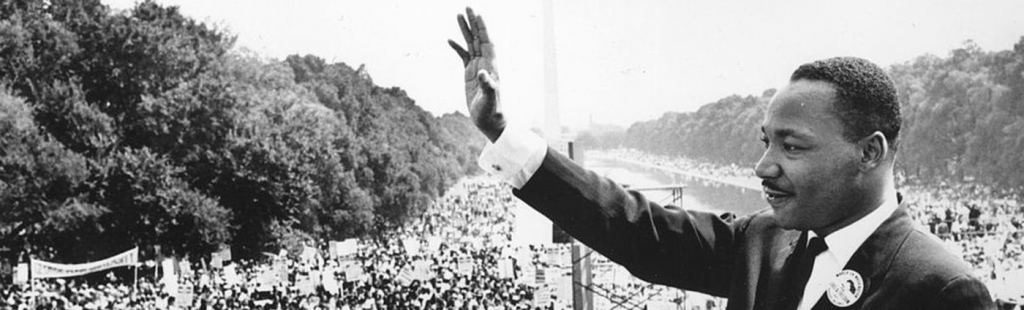
It’s Wednesday, August 23, 1963, and you are gathered with 250,000 others for a March on Washington. Now you find yourself gathered at the National Mall, facing the Lincoln Memorial and Dr. Martin Luther King takes the podium.

In the previous days, Dr. King and his speech writer, Clarence Jones, worked on a number of talking points for Dr. King to use on that day. A version of a speech was given to the event organizers beforehand and with that script and the notes prepared, Dr. King stepped forward.

For the first eight minutes or so, he spoke of liberty, equality and justice. But his words were not having the impact they deserved. That is until a close friend and favorite gospel singer, Mahalia Jackson shouted out

Martin. Tell them about the dream.

Some have said several of Dr. Kings advisors rolled their eyes and thought, “Oh no. Not the dream speech.”

You see Dr. King had shared his dream on several occasions before. Eight months earlier he spoke to an audience at a high school gym in Rocky Point, NC. And on other occasions it’s been told he exercised some of the same phrases that would eventually ignite this nation.

But it almost didn’t happen.

Clarence Jackson recounted that when Mahalia shouted for Dr. King to share his dream, he glanced over her way, gathered the prepared notes and papers that were on the lectern, pushed them off to one side and then grabbed both sides of the lectern. At that moment Clarence remembers telling the person next to him,

These people out there, they don’t know it, but they are about ready to go to church.

And we did.

Consider today, what is your dream? How many times have you shared it and it just didn’t hit home? I would encourage you to keep sharing it and improving on your message. Maybe the next time will be that moment when it lands perfectly, starts taking shape and changes lives.

Like Mahalia, allow me to encourage you,

Tell them about the dream.

Data without a Story is like a Palette without a Painting

A, B, C, D…we have 26 alphabet characters in the English language. We have 2 versions of each, upper and lower case. That gives us 52 characters from which to form words. This is the data.

But have you ever wondered where “upper and lower case” came from?
In the early days of printing, each character was represented on an individual block called a sort. Character sorts were selected and placed into composing sticks. Typesetters would select the characters from a case containing the sorts. Capital letters were stored in the back of the tray, as they were less frequently used. Trays when pulled out would be set upright so the capital letter would be on the top side, hence “upper case”. This is the story.

Now we are all familiar with our alphabet, so the story in this instance is not particularly helpful in helping you understand the data. However, it does help you understand the nomenclature around the data.

In many cases where we have data we are prone to share the facts and figures and expect the listeners to paint their own story as to why the data is important. In some cases, they may get it right. But when they get it wrong, when it’s not the story we appreciate, we get frustrated.

This is often due to “the curse of knowledge” which is the title of a post dedicated to this topic. We know the data and story so well we can’t imagine someone not seeing it as we do. Remember:

It’s not what you say that matters, it’s what people understand that matters.
So if your listener doesn’t understand, it’s not their problem…it’s yours.

At other times, it’s just because we know the data and haven’t imagined the story. If you are presenting data in an effort to get someone to make a decision, this is most likely not going to work. Simon Sinek in his very popular “Start with Why” TED Talk explains that people don’t make decisions based on what you do, but rather based on why you do it.

We have great data and powerful insights that can help shape life on this planet. But it’s our, it’s your responsibility to leverage that data in a way it has impact and meaning. Stories help you do that.

If you are wondering what that looks like, I point you to the late Hans Rosling who passed in 2017. His “Best Stats You’ve Ever Seen” TED Talk is considered to be one of the most informative and enchanting performances of data. If you watch his video you will see how he uses tools of storytelling, like dialog and flow of events to make the data jump off the screen and into the minds and memories of his listeners

So if you are a data scientist, my hat is off to you. Your curiosity and analytic skills are key to understanding the almost infinite amount of information available to each of us. Your observations and findings are incredible and important. I challenge you to not leave it there. Behind the data there are great stories as to why it’s important. So when you are sharing, start with why. Tell a data illustrated story.

If you have any questions or comments on this, please let me know.